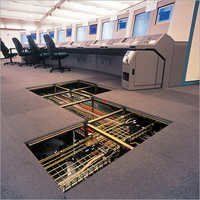
 Since every space is different and every design is driven by specific requirements, we decided to create a list of 5 benefits that raised floor systems can offer to almost any application.
1) They Help to Optimize Air Flow
In every work environment, proper airflow is required to maintain worker comfort and energy levels as well as general health standards.
Raised floor systems are designed to be designed as a means of guiding perforated and / or planed floor panels with minimal distortion between supply (usually located in the ceiling cavity) and return (to be placed under the floor).
Such systems are particularly useful in data centers and cleanroom applications that maintain rigorous temperature control measures, pollution control measures, air particle sizing and laminar air flow requirements.
The benefits can also be used as a tool to eliminate excessive condensation problems in any space where the air conditioner can be placed under the floor, especially from upper HVAC systems.
2) Increase Available Space
Raised floor flooring In almost any industry or commercial capacity, bulky grid systems can be placed effectively under the raised access floor. The resulting space savings can leave more space for staff and production equipment and potentially reduce the need for costly expansion.
With utilities and support systems neatly arranged under the floor, routine systems maintenance can be carried out almost anywhere via movable access panels. This helps to remove restrictions in the workspace and limit disruptions to the general work environment.
3) Efficient Restructuring
Many applications require the ability to customize and rearrange floor space to accommodate raised floor dynamic work environments.
RAF systems allow employees to easily rearrange the layout of a space without losing access to power and data outputs or having to move and work around many supporting utilities.
While performance phases and raised floor systems price are an extreme example of such dynamic workspaces, more and more businesses need flexible floor plans for cyclical product exhibitions, exhibitions, and events.
4) Provide Perfect Horizontal Work Surfaces
In retro-fit applications, adjustable raised floors can solve problems with variable or uneven floor height and create a perfect floor plan with further optimization potential.
The importance of a perfectly level work surface should not be overlooked even in high and automated working environments. When machines have to work for a long time and with a large number of moving parts, the need for a flat surface is paramount. Any imbalance or imperfection in the motion of the equipment can lead to expensive and disastrous consequences. The same applies to work environments that require precision.
Raised floor systems in such environments must maintain their flat surface and structural integrity throughout all forms of heavy use and vibration.
5) Help Improve Budgets and Programs
In addition to the cost and time savings that can only be achieved during the installation process, raised floor systems ultimately create value with all or any combination of the above advantages. Taken together, these benefits lead to overall increases in operational efficiency. In turn, this efficiency aggregates over the life of the product and translates into better budgets and programs at the general meeting.
 Flooring Systems